

The room
nobody
was designing
for
Loneliness
Capstone project, team of 6 · UX Interaction Design
Nomi
Tasks
Design lead
Prototype direction
Document Design
Presentation Design
Directing the interaction model prototype and unifying individually-developed widgets into a cohesive interface
Home
A digital family board, mounted on the wall as a piece of furniture, built for older adults living alone. Designed for Murrindindi Shire Council as part of a brief to support ageing in place community, either as a feature built into new housing developments or as a standalone product sold on its own. Most existing solutions on the market handle physical safety. We chose to build for the forgotten gap: loneliness.
Tools
Figma
Photoshop
InDesign
Miro

1 in 4 Australians age
65+
Live alone
AIHW (2026), Older Australians, citing ABS 2016 Census
Most assistive technology for ageing in place handles physical safety like fall detection, medication, emergency alerts. Necessary, but those are only half of the problem.
The other half is their mental, and it's the half people avoid to talk about. Strong social ties can extend life expectancy by 50%, and weak ones carry health risks comparable to smoking. Yet admitting you're lonely can feel like admitting you're a burden, so older adults living alone tend to hide it rather than name it, even from the people who'd want to know.
The
Problem
They won't ask. You won't always know to call. More than half of Australians see their family less than once a week.
(ABS, General Social Survey 2025)
Even a call can feel harder than it should, the right time, the right thing to say. Days pass, and neither of you reaches out.
But what if we could just be there at anytime without disturbing?

NOMI
A WINDOW TO YOUR FAMILY
The
Idea
Research approach
Six semi-structured interviews and a survey with older adults (65+)
Before designing anything, we listened. more than six interviews and a survey with older adults living independently, backed by research on ageing-in-place, surfaced the same feeling again and again.
I'm actually a little scared that when I retire, I might feel the loneliness more strongly.
field testing - participant 2
My children are busy with their own lives, and it feels so fulfilling when they include me sometimes.
field testing - participant 1
I just want to feel close to my family but they lives so far away
field testing - participant 6
Some weeks pass with no one around. I just sit with my memories for company
field testing - participant 3
field testing - participant 2
[ smart technology topic ]
I don't like asking for help, but I end up needing my children to fix it
field testing - participant 5
It feels great when my children remember to include me in things

.jpg)
Before \\\
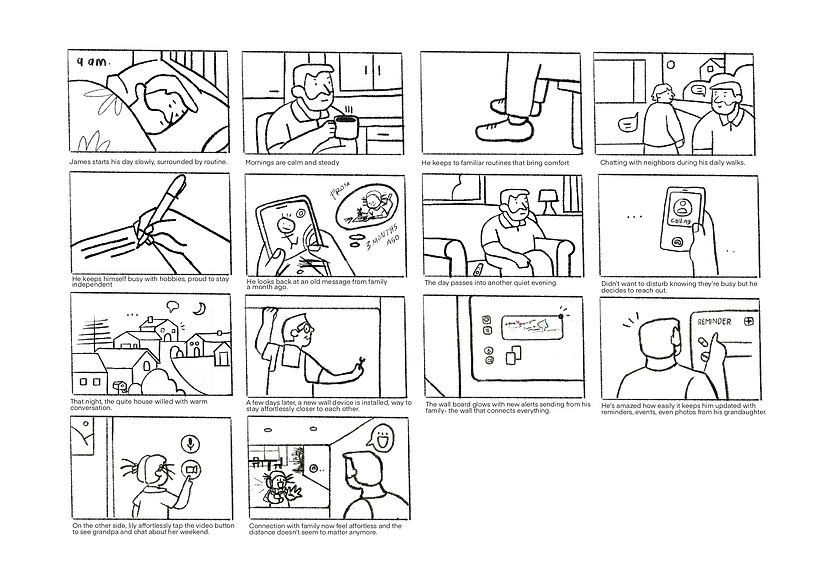
James starts most mornings with routine - breakfast, a walk, the news. Video calls with family happen sometimes, but they feel more like checking in than truly being together. On quiet evenings, comfort with technology doesn't bridge the emotional distance.
Scenario
After ///
A life-sized video call makes family feel like they're in the room together. On quieter days, the shared board keeps him updated, drawings, reminders, photos from his grandchildren. Even on quiet days, he still feels part of the family rhythm, no more lonely evening.

Usability testing
Field observations, key findings and design responses from real-world testing
Field testing included Evelyn and other participants who walked through the shared board, reminders, and Gallery. Sessions were observed and transcribed for behavioural and verbal feedback.
What I found :
I like that I could just leave this open all day like a family giant screen
Participants responded well to the large screen and voice prompts, describing them as friendly and less intimidating. But the interface felt cluttered on first use, too many info at once, and touch actions needed clearer visual or sound feedback to confirm they'd worked.
It's a beautiful idea... friendly and less intimidating.
The scale and voice prompts made the technology feel approachable rather than technical.
Reminders like watering plants or taking medication turned into something I could tick off, proof I'm still doing okay on my own
Ticking off daily tasks gave users a tangible sense of accomplishment.
It felt like having them in the room again
Seeing a family photo appear unexpectedly created a genuine emotional response during testing.
Iterations :
-
Feedback cues added for touch and voice actions (a soft glow or chime) so users know an input registered
-
"My People" widget simplified, fewer elements shown at once to reduce visual clutter
-
Onboarding sequence introduced to reduce the "too many buttons" first impression
-
Reminders reframed as a checklist to reinforce a sense of independence and accomplishment